1. Proactive Sanctions Compliance and Behavioral Risk Detection
Advanced AI, such as Windward’s Maritime AI™ platform, fundamentally shifts maritime security from reactive screening to proactive risk management.
• Anticipatory Risk Identification:
Maritime AI™ continuously monitors vessel behavior, ownership changes, and network links, surfacing crucial risk indicators before official sanctions are implemented. This provides a critical window for customers to act early and reduce exposure. For example, in 2025, Windward flagged over 99% of vessels sanctioned by the EU, UK, and U.S. before their official designation.
• Detection of Deceptive Behavior:
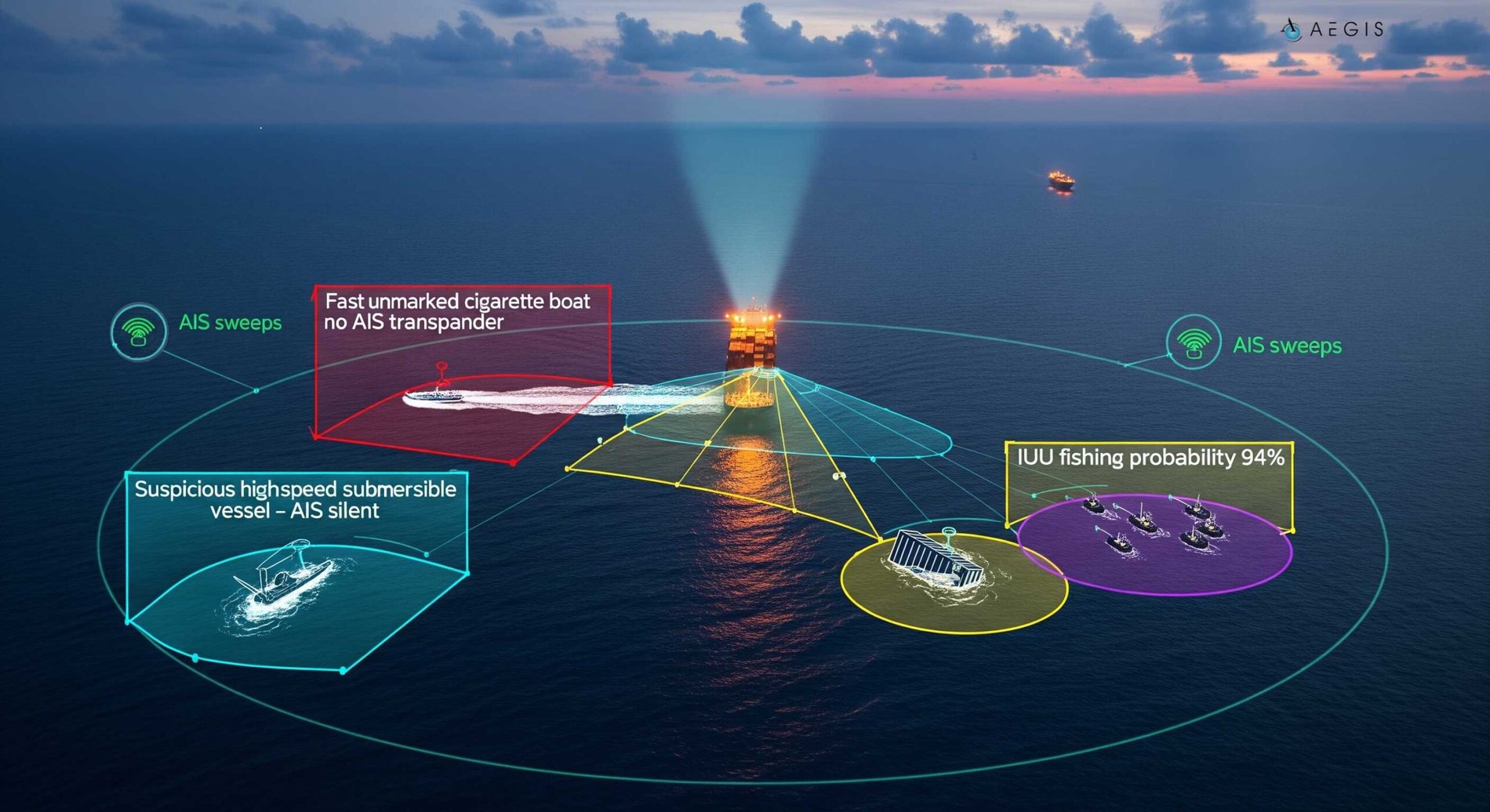
Real-world behavioral data is essential because modern maritime threats do not broadcast their intentions; they exploit crowded waterways, disable AIS, and manipulate identifiers. Behavioral risk is now outpacing static screening methods, which cannot keep up with the velocity of evolving bad actor tactics. The AI systems detect deceptive shipping practices (DSPs) such as:
- GPS spoofing and jamming.
- AIS gaps and dark activity.
- Suspicious ship-to-ship (STS) transfers in high-risk areas.
- Fraudulent flagging and false port calls, which obscure a vessel’s true movements and cargo.
2. Enhanced Physical Security and Situational Awareness
Advanced AI, particularly machine vision technology, plays a critical role in enhancing the physical security of vessels by providing heightened situational awareness and detection capabilities that surpass conventional systems.
• Intelligent Object Detection:
Systems like SEA.AI compute data from lowlight and thermal on-board cameras using cutting-edge machine vision technology and best-in-class deep learning capabilities. The AI is trained on a proprietary database of millions of annotated marine objects.
• Perimeter Monitoring:
This technology enhances security by detecting approaching boats or objects, such as unsignalled craft, floating obstacles, inflatables, kayaks, or persons in the water, even if they are eluding conventional systems like AIS or radar. In 360° surveillance mode, the system provides alerts to security staff 24/7.
• Counter-Unmanned Aerial Systems (CUAS):
AI-enabled command and control (C2) software, such as MARSS’ NiDAR, is crucial for counter-drone measures. The proprietary AI handles UAS classification by fusing inputs from various sensors (radar, optical, passive RF sensors) and analyzing behavior pattern recognition, object data points, and event history. This capability detects small to midsize drones out to significant ranges, providing critical notice to the crew.
By leveraging AI and real-time behavioral data, maritime security shifts from simply reporting what is already known (static screening) to showing what is happening now, allowing for predictive and intelligence-driven decisions.