

High-level maritime security training in 2026 focuses on integrating traditional ship and port security with cyber, digital certification, and “blue crime” threats, aligned with evolving STCW and ISPS expectations.
Introduction – Why 2026 Is a Turning Point
Port State Control and flag states are treating security training as an operational priority rather than a formality, and security awareness is now routinely checked during inspections. At the same time, new STCW-related updates and digital, QR‑verified certificates are reshaping how seafarers prove competence across borders
For operators, this means high-level maritime security training must go beyond checkbox compliance and build resilient people, processes, and digital systems.
Core Regulatory Foundations (STCW, ISPS, Law)
In 2026, every seafarer is expected to hold Security Awareness certification, while those with additional duties must complete Designated Security Duties, embedded as a core competency under STCW and the ISPS Code. High-level training therefore revisits not just the letter of the convention, but how security culture shapes everyday decisions on bridges, in ECRs, and within port facilities.linkedin+2
Advanced courses increasingly integrate maritime security law and international cooperation, clarifying liabilities, rules of engagement, and how UN‑level initiatives frame responses to piracy, smuggling, and other maritime crime. Participants learn how evolving legal expectations intersect with flag state guidance, coastal state control, and private security contracts.
From Physical Threats to “Blue Crime”
New high-level programs focus on “blue crime”: the spectrum of transnational threats at sea, from illegal fishing and trafficking to sabotage and environmental crime. Courses aim to give decision‑makers conceptual tools for understanding multidimensional maritime challenges and for building regional resilience and social cohesion at sea.
This lens forces training to move beyond single‑threat drills and into complex, multi‑agency scenarios that reflect the real Atlantic and Indo‑Pacific security environment. Officers and managers practice aligning shipboard procedures with national strategies, naval operations, and coast guard capabilities.
Technology, Cyber Security, and Autonomous Systems
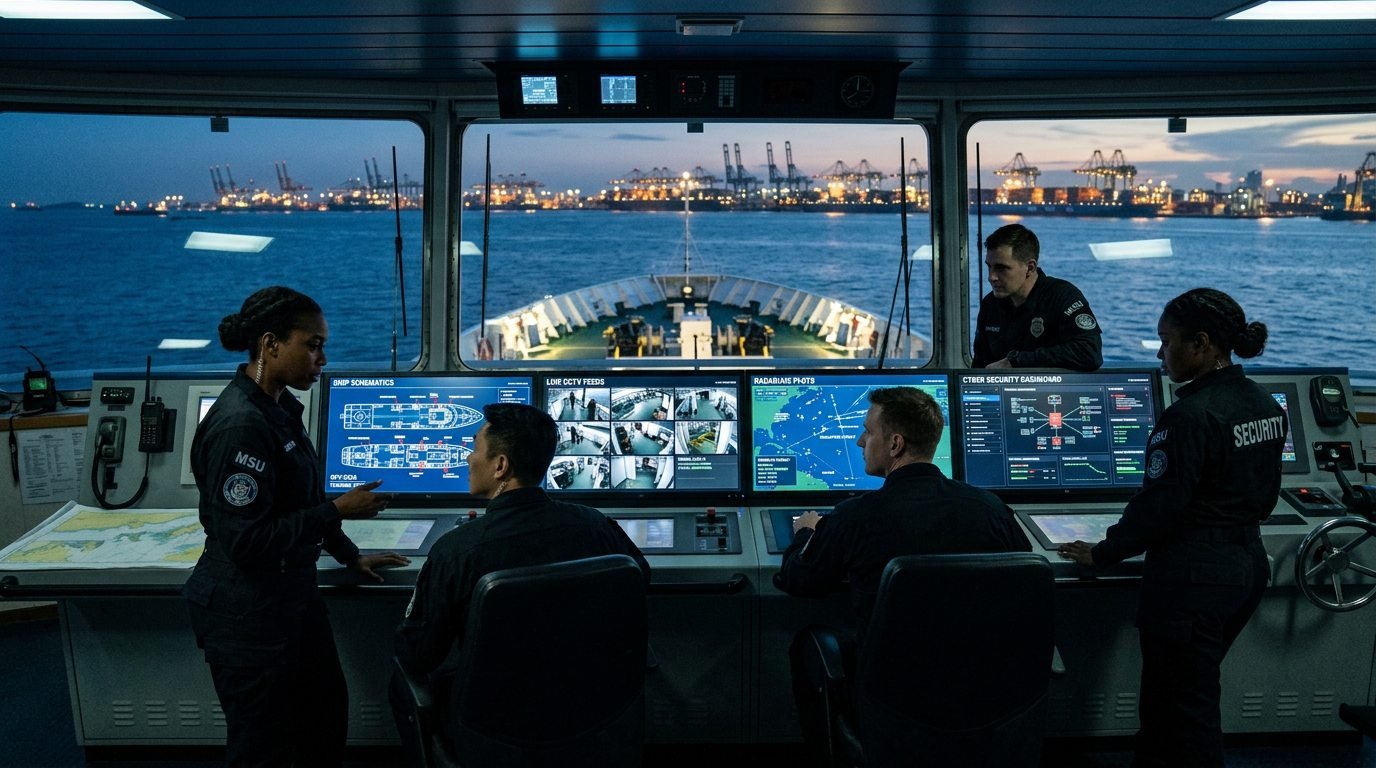
High-level maritime security training in 2026 now treats cyber risk as part of a seafarer’s core security skill set, not a specialist niche. Scenario‑based modules link cyber incidents directly to navigation errors, operational delays, data breaches, and safety risks so crews see cyber as a safety issue, not just an IT problem.
Training also covers advanced surveillance and detection technologies—thermal cameras, side-scan sonar, and AI‑driven analytics—which are increasingly deployed to enhance situational awareness and threat detection. As unmanned and autonomous systems proliferate, officers must learn both to exploit these tools for protection and to counter their malicious use for smuggling, illicit surveillance, or sabotage.
Training Design: From Checklists to Resilience
Leading maritime security courses combine classroom learning with tactical, scenario‑based training, live‑vessel exercises, and joint drills so that participants can apply doctrine in realistic conditions. Programs for maritime security operatives, for example, blend team-based exercises, live vessel operations, and mission‑oriented planning to build confidence in high‑risk environments.
At management level, 2026 summits and courses highlight the importance of multi‑agency collaboration, intelligence integration, and information sharing as core training outcomes. The goal is to produce leaders who can operationalize robotic and autonomous systems, coordinate with diverse partners, and maintain domain awareness across complex sea areas.
Credentialing, Verification, and Continuous Learning
Electronic, QR‑verified certificates aligned with STCW 2026 updates are making it easier for companies and inspectors to authenticate security qualifications globally. This reduces fraud risk and supports remote, blended training models that still meet stringent international standards.
For shipowners and managers, the strategic priority is shifting to continuous security learning pathways that combine basic awareness, designated duties, cyber security bundles, and periodic refreshers. Organizations that embed these high-level concepts into their Safety Management Systems will be better positioned for tighter inspections and a more contested maritime domain through 2030.ondecksailing+3
Would you like this shaped further for a specific audience segment, such as shipowners, private maritime security companies, or superyacht operators?